Chapter 4 Retrieval plans and tuning
Chapter guide: Chapter 3 left all three document types "ready"—but "findable" and "accurate" differ. This chapter picks a retrieval plan for
after-sales-kband tunes it: understand the full retrieval chain; choose semantic, full-text, or hybrid by document shape—full-text backend follows vector DB, Milvus users also BM25 migration; hybrid usually needs rerank; close parameters with quote limits, minimum relevance, and question optimization—policy manual and product FAQ each get their own set. After this chapter you can: pick a plan per document type, tune until cited content is reproducible, and verify tuning via chat details.
All data must be ready"] --> B{"Pick plan by doc shape (4.2)"} B -->|"Natural language · paraphrase hits"| C["Semantic search (4.3)
Index model · minimum relevance"] B -->|"IDs · SKUs · error codes"| D["Full-text search (4.4)
Milvus BM25 or Mongo tokenize"] B -->|"Both question styles"| E["Hybrid search (4.5)
Rerank then filter"] C --> F["Tune parameters (4.6)
Quote limit · minimum relevance
Question optimization optional"] D --> F E --> F F --> G["Verify in chat details (4.7)
Each doc type its params"]
Chapter operation flowchart
When you need it
Three typical situations, three ways to use this chapter.
Data ready but answers are off—follow Section 4.6 symptom-first (not found, too broad, wrong order), then Section 4.2 plan switch. First discipline: locate by phenomenon; do not tune everything at once.
Users ask with ticket numbers, error codes, SKUs—semantic search misses—Section 4.4: keyword full-text fits exact queries; backend follows vector DB; Milvus needs BM25 migration step.
Library mixes Q&A pairs and long docs—sometimes miss, sometimes flood—Section 4.5 hybrid plus rerank for precision; quote limits by tokens for stability. The quote limit is not a topk cap: official docs avoid topk for quotes because chunk lengths vary wildly in mixed libraries. Semantic recall still uses topk—that is a separate layer (Section 4.3), not a blanket retirement of topk.
Prerequisite: Chapter 3 three types "ready", index model available (not ready → Section 3.4).
4.1 Overview: six-step retrieval chain
One KB search is not "question → vector DB → results." Official overall plan: FastGPT combines text, images, semantic recall, full-text recall, question optimization, rerank, then fuses into quoted content. Six steps:
Coreference · expansion"] --> B["Multi recall
Semantic · full-text · hybrid"] B --> C["RRF fusion
Merge multi-channel results"] C --> D["Rerank (optional)
ReRank second pass"] D --> E["Filter and trim
Minimum relevance · quote limit"] E --> F["Quoted content
To generation model"]
Six-step KB search (official overall plan; rerank optional; image recall when model and indexes support)
After-sales domain is text-only—image chain omitted unless visual model, image-capable embeddings, and image indexes at ingest (official matrix for combinations—see source).
What drives precision
Official vector search emphasis (Chapter 3 partial quote): precision depends on embedding model quality, data quality (length, completeness, diversity), retriever precision (speed vs accuracy tradeoff); plus query quality. Embedding model fixed in Chapter 2; data quality Chapters 3.3–3.4; retriever and query quality Sections 4.3–4.6.
Storage and merge: why multi-hit ranks higher
Storage example: PG Vector HNSW (replaceable engine—Chapter 2 four-way choice); MongoDB for other data. dataset.datas holds vectors; indexes is array of vector IDs—one data row, multiple vectors.
Recall: vectors first, then Mongo lookup by vector ID; if multiple channels hit same data, merge, vector score = max score. Explains Section 4.5: multi-channel hit tends to rank higher.
4.2 Retrieval plan panorama: semantic, full-text, hybrid
Three search modes plus rerank toggle. Comparison:
| Plan | Principle | Fits | Weakness | Depends on |
|---|---|---|---|---|
| Semantic search | Vector distance → mathematical similarity | Natural language, semantic neighbors, cross-language | Model-dependent, unstable, keywords and sentence completeness | Index model (Chapter 2) |
| Full-text search | Classic keyword hit | IDs, SKUs, proper nouns, error codes, key subject-verb | Paraphrase misses | Vector DB backend (Section 4.4) |
| Hybrid search | Vector + full-text, RRF merge | Libraries with both styles; usually richer | Large scope, hard similarity filter—usually needs rerank | Full-text backend + rerank recommended |
UI is the KB search test "search config" dialog—local community v4.17.3 (2026-11-03, glm-5.3-flash + embedding-3):
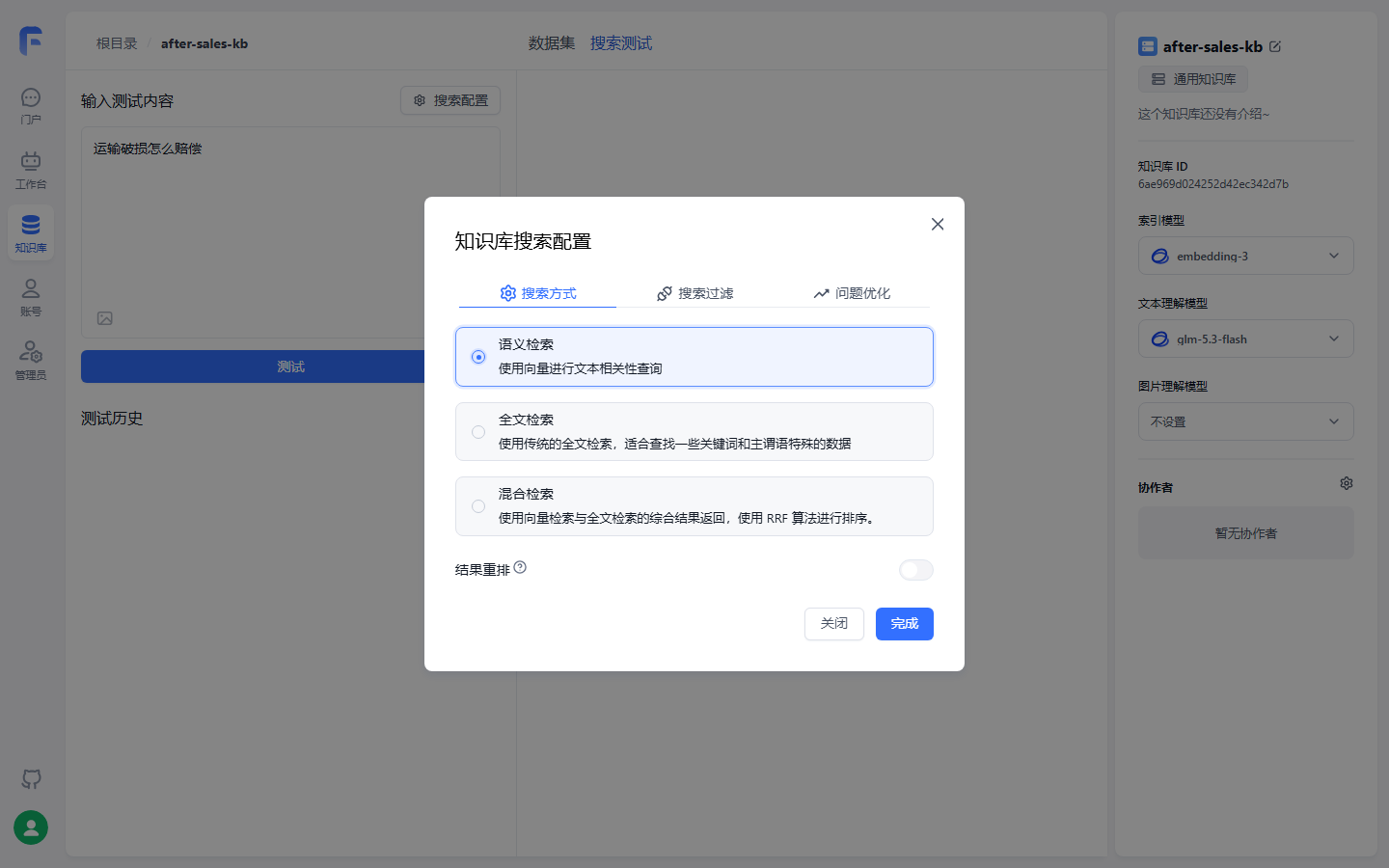
Three options map to Sections 4.3–4.5; rerank is separate switch, not a fourth mode.
RRF (Reciprocal Rank Fusion) merges paths—final quotes not strictly single-channel vector order—multi-hit rows tend up.
Pick plan by document shape
Official: semantic for natural language; full-text for IDs and codes; both → hybrid. Thread-through: policy manual natural language plus "article N" citations; FAQ is Q&A shaped. Our recommendation: after-sales-kb default hybrid—half colloquial half coded; semantic alone for light FAQ-only libraries.
4.3 Semantic search: embedding model and similarity filter
Pros and cons
Similarity is mathematical, not literary. Semantic recall still uses topk: take the top k nearest chunks, then hand them to the LLM. That is not the quote limit. The quote limit trims cited tokens and does not use topk (Section 4.6).
| Pros | Cons |
|---|---|
| Near-semantic understanding | Model training dependent |
| Cross-language | Unstable precision |
| Multimodal (model-dependent) | Keywords and completeness sensitive |
Similarity filter: minimum relevance
Minimum relevance 0–1 filters low hits. Official: only effective in semantic search or when rerank used; filter threshold, not final sort—optimization, hybrid, image, rerank change ordering.
Five ways to improve semantic precision
Official five methods; two opposing directions:
Single complete semantics"] BASE --> M2["Lean index
Shorter, stricter
Less recall range"] BASE --> M3["Rich index
Multiple indexes per row"] BASE --> M4["Better query
Question optimization"] BASE --> M5["Fine-tune embeddings
Domain gains"]
Five methods (official; M4 = Section 4.6 optimization; M1 echoes Chapter 3 chunk conditions)
Chapter 3 tradeoff: lean index raises precision, shrinks recall; rich index adds indexes—any hit recalls row; annotate chunks. Choose by missing precision vs recall.
Limits and common mistakes
- Missing subject/coreference hurts—reason for question optimization (Section 4.6).
- Fine-tune costly—book case stops at data and free params.
4.4 Full-text search and BM25: backend follows vector DB
What full-text solves
Classic keyword retrieval—IDs, codes, SKUs more reliable than semantic alone.
Chapter 2 foreshadow: full-text backend follows vector DB, no separate switch.
| Vector DB | Full-text backend | Note |
|---|---|---|
| Milvus (≥ 2.5.16) | Milvus BM25 | Vectors + full text in modeldata_v2; no Mongo full-text table; default language lingua, MILVUS_LANGUAGE_IDENTIFIER=whatlang for speed |
| PG / OceanBase / SeekDB / openGauss | MongoDB $text + jieba |
Default path (openGauss extra in docs; Chapter 2 four-way may exclude) |
Thread-through on PgVector uses Mongo $text + jieba—BM25 migration below for large scale or stronger full-text.
Milvus BM25: upgrade and migration
Milvus upgrade to BM25 needs ≥ 2.5.16—below, FastGPT startup errors, no degrade. Official eight steps:
| Step | Action | Points |
|---|---|---|
| 1 Backup | Milvus volumes, etcd, MinIO, Mongo business data | Rollback |
| 2 Pause writes | Low traffic or stop app writes | No concurrent dataset writes |
| 3 Upgrade Milvus | Image milvusdb/milvus:v2.5.16 |
Keep volumes and legacy modeldata |
| 4 Verify version | FastGPT getVersion(); milvus-cli/attu/SDK |
Wrong version stops boot |
| 5 Migrate | dry-run then real | Copy only, no re-embed; resume, idempotent |
| 6 Verify | status: done, targetCount >= processedCount; smoke full-text/hybrid |
Empty modeldata_v2 → no full-text hits |
| 7 Drop old | removeOld=1 or manual drop modeldata |
Not auto-deleted |
| 8 Rollback | Before drop: downgrade + restore; after drop: restore Milvus volume | Step 7 not rushed |
Migration API (rootkey = your ROOT_KEY):
# 1. dry-run stats first
curl 'http://host/api/admin/4162/milvus?dryRun=1' \
  -H 'rootkey: 你的ROOT_KEY'

# 2. formal migration
curl 'http://host/api/admin/4162/milvus?batchSize=500' \
  -H 'rootkey: 你的ROOT_KEY'

# 3. gateway timeout—resume with migrationId
curl 'http://host/api/admin/4162/milvus?resumeMigrationId=<uuid>' \
  -H 'rootkey: 你的ROOT_KEY'
Migrates old modeldata, Mongo dataset_datas.indexes text, writes modeldata_v2; imageEmbedding copies vector only, BM25 text empty; verifies row count.
Limits and common mistakes
Milvus version ... is not supported→ upgrade Milvus.- Old
modeldatamissing → wrong instance/volume; restore backup. failedandtargetCount < processedCount→ Milvus health,resumeMigrationId.- Full-text empty after migration → confirm
done, checkmodeldata_v2.
4.5 Hybrid search and rerank
Hybrid: two channels, RRF
Vector + full-text via RRF—usually richer. Cost in same doc: large scope, cannot similarity-filter directly—usually rerank then filter by rerank score.
Rerank: more trustworthy score
ReRank second sort—usually improves accuracy.
| Point | Official |
|---|---|
| Rerank score more precise than vector | 0–1 filterable |
| Needs complete questions | Often optimize question before search |
| Multi-channel still RRF after rerank | Rerank + vector + full-text fused |
Rerank wired in Chapter 2 model channels; optional fifth type with requestUrl, requestAuth. FAQ "cannot check rerank" mentioned config.json—4.15.0+ uses env (Section 2.3); actual checkbox path pending review.
Limits and common mistakes
- Extra model call adds latency—small libraries may get by with semantic + minimum relevance.
- Rerank not magic—"still wrong order" row says check question completeness and candidate pool first.
4.6 Search parameter tuning: quote limit, minimum relevance, question optimization
Two filters and one switch
Mode (Sections 4.2–4.5) plus filter layer:
| Parameter | Mechanism | Constraints |
|---|---|---|
| Quote limit | Max n tokens quoted per search | Official docs do not use topk to cap this layer—mixed chunk lengths make a topk quote cap unstable; tokens are steadier. Semantic-recall topk remains (Section 4.3); it is not retired here |
| Minimum relevance | 0–1 filter | Semantic or rerank only; filter not sort |
| Question optimization | Coreference and expansion before search | Extra model call; optional for clear questions or speed |
Quote limit has two layers: search-side max tokens per search vs model-side quoteMaxToken (Chapter 2)—do not confuse when tuning.
Question optimization: complete questions for multi-turn
KB search uses only current question—e.g. user asks "what is the second point," search gets six characters. Optimization before retrieve; view complement in chat details after each turn—main tuning verification window; extra call—official says trade off; avoid over-optimization on exact ID questions per tuning table.
Tuning route: phenomenon first
Official discipline: do not tune all params at once. Phenomenon table (image rows for reference; after-sales text-only):
| Phenomenon | Check and adjust first |
|---|---|
| Cannot find content | Training done; lower minimum relevance; raise quote limit; short or incomplete question |
| Too broad, off-topic | Raise minimum relevance; lower quote limit; better chunks; irrelevant fragments |
| IDs, SKUs, codes miss | Full-text or hybrid; lower semantic weight; avoid over-optimization on exact IDs |
| Natural language misses | Semantic or hybrid; optimization on; better indexes |
| Slow after optimization | Faster optimization model or only multi-turn/short questions |
| Still wrong after rerank | Question complete; enough candidates; relevance and quote limit |
| Weak image search | Image-capable model; image indexes at ingest; clarity |
| Unstable text+image | Prioritize text vs image; reduce extra text for image-only |
Steering wheel: change one param, same question, chat details; or KB search test tab.
Search test screenshot—query "运输破损怎么赔偿" in testing requires English gloss in prose: the Chinese test query means "How is damage in transit compensated?"
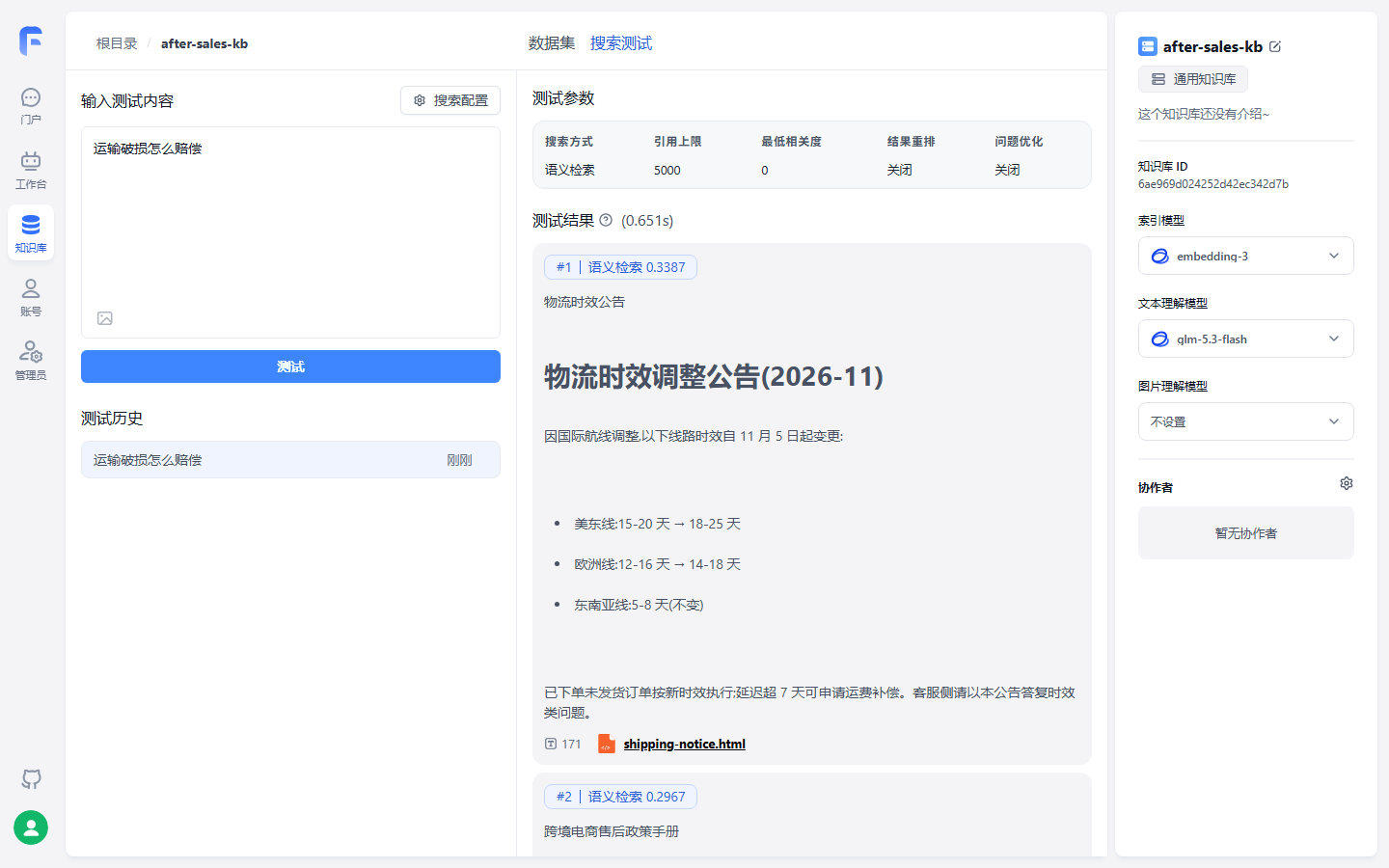
Notice top semantic hit is logistics notice not policy—math similarity nature; Section 4.7 differential tuning addresses this.
Limits and common mistakes
- Only minimum relevance and quote limit documented for filters;
metadatafilter behavior undocumented—review with Chapter 3. - Search test works in testing (2026-11-03, figure above); param persistence per library undocumented—app chat details remain full loop.
4.7 Hands-on: differential tuning for three document types
No universal defaults—stance table by document shape (book stance, verify on your library):
| Document | Dominant questions | Plan | Parameter lean | Rationale |
|---|---|---|---|---|
| After-sales Policy Manual | Natural language clauses + "article N" cites | Hybrid + rerank | Strict minimum relevance; optimization on | Official: hybrid richer; rerank usually helps |
| Product FAQ | Colloquial near Q&A text | Semantic start | Optimization as needed; quote limit low impact | Semantic fits natural language |
| Shipping time notices | Carrier names, day counts | Hybrid, full-text lean | Minimum relevance applies only for semantic search or when rerank is on. This row uses hybrid search and does not turn rerank on; there is no measured record of rerank enabled here, so the looser threshold does not apply on this row. Keep the "do not drop short notices" lean for when one of those two conditions holds. Quote limit caps overlapping old and new notices | Full-text for proper nouns |
Three shared rules from official table:
- One param at a time—retest same question;
- Not found → training first (Chapter 3 "ready");
- Params follow data—Chapter 3 index lean/rich and preview cap what params cannot fix.
Tune order: three plan sets, fixed test questions per type, verify quotes in chat details. Chapter 7 moves params into workflow search node for "售后客服" ("After-sales Support").
Chapter summary
- Six steps: optimize → multi recall → RRF → rerank (optional) → filter → quotes; fused order not pure vector.
- Pick by shape: semantic / full-text / hybrid—hybrid default for
after-sales-kbin business terms. - Full-text follows vector DB: Milvus BM25 vs Mongo
$text; eight-step migration; old table not auto-deleted. - Minimum relevance is filter not sort: semantic or rerank; rerank 0–1 often better filter.
- Quote limit is tokens, not a topk cap on quotes; semantic recall still uses topk (Section 4.3). Distinguish the quote limit from
quoteMaxToken. - Phenomenon table steers; optimization costs a call; chat details verify.
Next: build and search done—operations is "keep current." Chapter 5 sync, tags, permissions; Chapter 3 three sync routes land there.
Acceptance checklist
You should be able to:
- ☐ Draw the six-step chain and name the one optional step marked on the figure (rerank), plus the step that depends on model capability;
- ☐ Match three modes to question styles and justify plan for new doc;
- ☐ Explain full-text backend vs vector DB and Milvus BM25 prerequisites;
- ☐ State minimum relevance two constraints;
- ☐ Separate the search-side quote limit from model-side
quoteMaxToken, and say why the quote limit is not a topk cap while semantic recall still uses topk; - ☐ Two phenomena → two adjustments each;
- ☐ Three doc types: plan + lean, verify in chat details.
Review list (before publish)
- [ ] UI vs v4.17.3 docs listed, verified 2026-11-01;
- [x] Search UI names verified (2026-11-03)—five controls in config and test (Sections 4.2, 4.6 figures);
- [ ] Param ranges exhaustive;
- [x] Search test behavior (2026-11-03)—returned scores in figure; save per library not checked;
- [ ] Rerank checkbox path post-env migration;
- [ ]
metadatafilter with Chapter 3; - [ ] Section 4.7 leans hands-on;
- [ ] BM25 migration four API steps on Milvus env;
- [ ]
MILVUS_LANGUAGE_IDENTIFIERlingua vs whatlang; - [ ] Mermaid GitHub render.
Further reading
- Chapter 3—chunk quality, index lean/rich, metadata are tuning ceilings.
- Chapter 5—sync and tag dimensions on FAQ categories.
- Chapter 7—workflow search node applies this chapter's params.
- Chapter 11—migration methodology; BM25 one path.
- (→ ragflow book) Chapter 7—parallel retrieval test methodology.