Chapter 3 Virtual keys
The master key lets curl get a "still in transit" answer for OD-2049. Writing it into
xbd-seashore-cs-agenthands the right to issue keys to the support process. This chapter first looks at alice and bob, already seeded in the Admin UI, then returns to the issuing API to separate the fields in the response that actually constrain anything from those that are only echoed back.
/team/new"] --> B["seashore-main
and aurora-main"] B --> C["/key/generate
with models and team_id"] C --> D["key in the response
appears only once"] D --> E["The business stores
only the virtual key"] E --> F["/v1/models
shows only allowed aliases"] F --> G["A bad key
401 token_not_found"]
Procedure for this chapter
alice and bob in the UI
On 2026-11-12 the Virtual Keys page had two rows. The key plaintext is masked. The team, the budget, and the models are still visible.
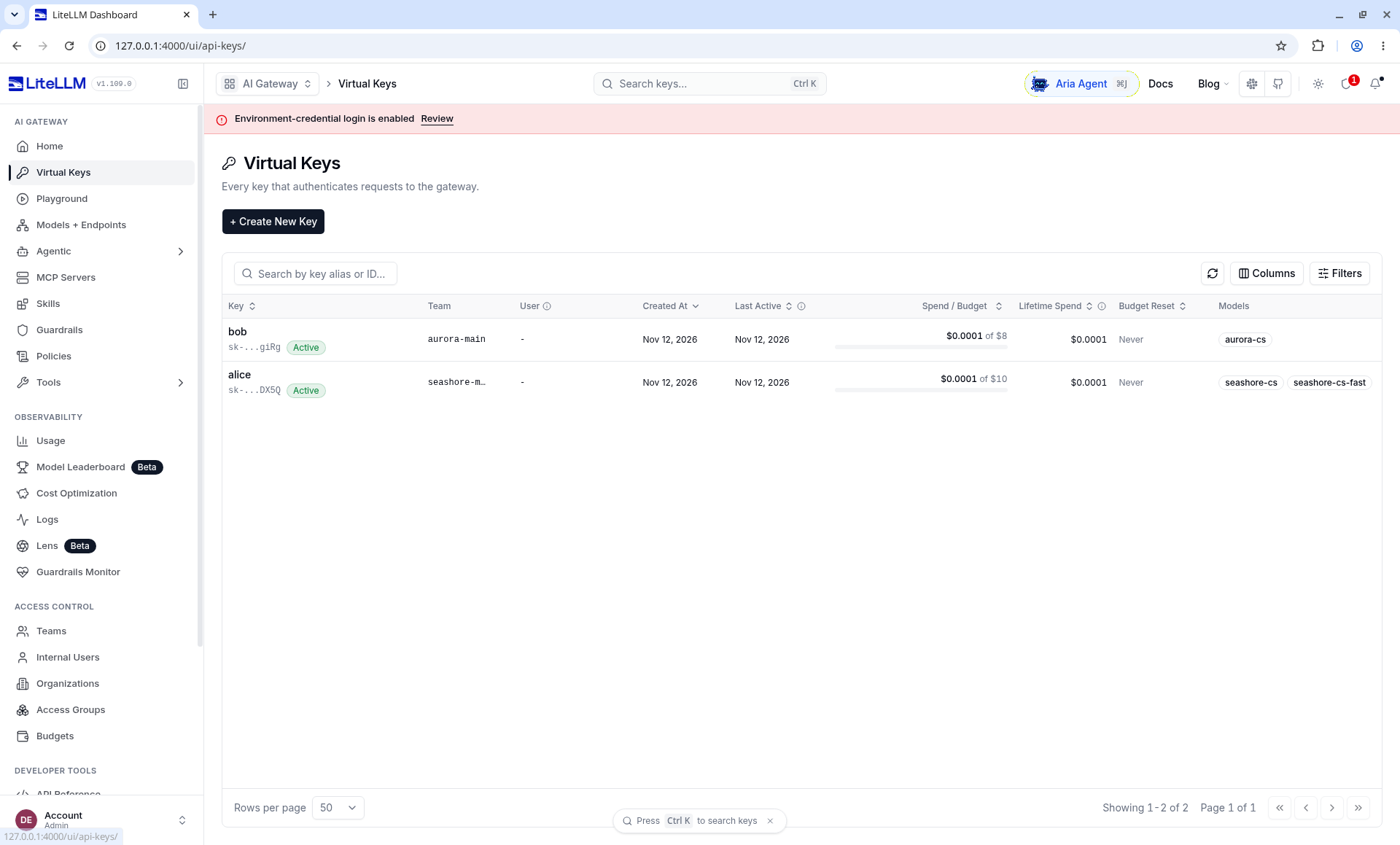
What this table can answer, and what it cannot, stay separate:
| What you can read off this table | Not on the table. Do not fill it in |
|---|---|
Both keys are Active. The user column is - |
The last four characters g1Rg and DX5Q belong only to this database. Rerunning seed.sh replaces them |
bob belongs to aurora-main, budget $8. alice's budget is $10, and the team name is truncated to seashore-m... |
Truncation does not mean the team failed to be created. The full name on the Teams page is seashore-main |
The model column shows aliases: bob has only aurora-cs. alice has seashore-cs and seashore-cs-fast |
The default columns do not include RPM. alice's rpm 30 and bob's rpm 20 were set when the keys were issued. This table does not show them |
| Spend shows $0.0001 for both. Budget Reset is Never | $0.0001 is coarser than the $0.000062 on the success log and in the Playground. Do not reconcile against the four decimal places in this column |
| Created At and Last Active are both Nov 12, 2026 | The table has no 403. alice calling aurora-cs was refused. That row is in the Request Logs in chapter 4 |
Calls made the same day with these two keys: alice calling seashore-cs returned HTTP 200, the body starting with [primary] 订单 OD-2049 仍在途。 ("[primary] Order OD-2049 is still in transit."), response headers x-litellm-model-id: seashore-cs-primary and x-litellm-attempted-fallbacks: 0, cost about $0.000062. alice calling aurora-cs returned HTTP 403, type key_model_access_denied. bob calling aurora-cs returned HTTP 200. The full 403 JSON was recorded on the 11th and appears in a later section. What the 12th confirmed is the status code and the type. Do not present the 11th's message text as if it were copied again on the 12th.
The dash in the user column is the same fact as "a key issued by an admin has no owner", later in this chapter. alice is not the shop-owner account at Seashore Select, and bob is not Aurora's shop owner. The shop owners are still alice and bob inside AgentScope. The gateway keys only borrow those names, so the screenshots line up with the merchants.
demo/seed.sh creates the four objects above with the master key: two teams and two keys. Run it once on an empty database. The key plaintext appears only in that output. After that the page shows only the mask. If it is lost, revoke and reissue. Do not expect this table to hand the sk- string back.
A team first, then a key
The two rows in the UI are the seeded state. The issuing order is still /team/new, then /key/generate. The 2026-11-11 calls below record the full field shapes, with different numbers: that day the Seashore key's key_alias was seashore-cs-agent and max_budget was 0.01. The screenshot's alice is 10 dollars, with rpm 30. Read the response body from the 11th's sample. Read the page from the previous section.
The order on the Virtual Keys page is: create a team, then issue a key for the team. Xingfan's two merchants correspond to two team_alias values, using the namespace names, so there is not a second naming scheme.
curl -sS -X POST http://127.0.0.1:4000/team/new \
  -H "Authorization: Bearer $LITELLM_MASTER_KEY" \
  -H 'Content-Type: application/json' \
  -d '{
    "team_alias": "seashore-main",
    "max_budget": 1.0,
    "budget_duration": "1d",
    "models": ["seashore-cs", "seashore-cs-fast"],
    "rpm_limit": 30,
    "tpm_limit": 20000,
    "metadata": {"namespace": "seashore-main", "merchant": "海岸优品"}
  }'
The team_id returned on 2026-11-11 is a UUID. budget_reset_at is 2026-11-12T00:00:00Z. The create time was about 15:48 UTC that day. members_with_roles contains default_user_id, role admin. organization_id is null. This book did not create an organization. The official enterprise page lists organizations near licensed capabilities. The open-source /team/new does not require an organization id, and the experiment did not fill one.
Aurora Digital gets a team the same way: team_alias is aurora-main, models is only aurora-cs, max_budget is 0.5, rpm_limit is 20. The two teams have different ids. Every key after this carries the matching team_id. If you drop the id and only write the merchant name in metadata, the gateway will not refuse a cross-merchant call because of that. The boundary of metadata is chapter 5. Store the id in the platform's tenant record here. Do not store it in Git.
Issuing the key for Seashore Select support
curl -sS -X POST http://127.0.0.1:4000/key/generate \
  -H "Authorization: Bearer $LITELLM_MASTER_KEY" \
  -H 'Content-Type: application/json' \
  -d '{
    "key_alias": "seashore-cs-agent",
    "models": ["seashore-cs", "seashore-cs-fast"],
    "team_id": "<seashore-main 的 team_id>",
    "max_budget": 0.01,
    "budget_duration": "1d",
    "rpm_limit": 10,
    "tpm_limit": 4000,
    "duration": "30d",
    "metadata": {
      "namespace": "seashore-main",
      "agent": "xbd-seashore-cs-agent",
      "order_anchor": "OD-2049"
    }
  }'
order_anchor is only there so a person can follow the experiment. It is not a query condition of the gateway. Production must not put the customer's original text into metadata.
The parts of the response body that matter to Xingfan:
| Field | Value this time | How to use it |
|---|---|---|
key |
Starts with sk-. This book does not paste it |
The full value appears only this once. Put it into the deploy system immediately |
key_alias |
seashore-cs-agent |
A name for people. It cannot authenticate |
team_id |
The Seashore team's UUID | Tied to the team budget |
user_id |
null |
See the next section |
models |
The two seashore aliases | Access control is this array |
max_budget |
0.01 |
Dollars. An experiment number, not support's real monthly budget |
rpm_limit / tpm_limit |
10 / 4000 | Chapter 4 used a smaller rpm and got a 429 |
duration |
null in the response |
The request wrote 30d. Do not trust this echo |
expires |
In /key/info it is 2026-12-11T15:49:12Z |
30 days after the issue time. Trust info |
metadata |
Returned as sent | The gateway stores it. It does not execute it |
blocked |
null |
Not disabled |
aliases |
{} |
No key-level alias was set this time |
/key/info shows the key as sk-... plus the last four characters, and gives key_name the same mask. created_by and updated_by are default_user_id. status is active. spend may still be 0 just after the call. Chapter 4 recorded the posting about two seconds later.
The shape of /key/list is keys, total_count, current_page, total_pages. This time the keys array on this machine held hash strings, not sk- plaintext. If the admin console only gives hashes, you cannot recover a lost key from the list. A lost key is revoked and reissued.
A key issued by an admin has no owner
The Virtual Keys page is explicit. The wording on 2026-11-11 is: the owner of a key is the user user_id points at, not necessarily the person who called /key/generate. When the caller is not a proxy admin, the API stamps the caller's user_id onto the key. A proxy admin must pass user_id themselves, or the new key has no owner and does not inherit the admin's quota and models. A service-account key's user_id is always null, under the same rule.
This machine issued with the master key, and the returned user_id is null. That is expected. It is not a dropped field. The consequences have to be remembered separately:
| Side | What the docs say is inherited | When there is no owner |
|---|---|---|
| Models | With no team_id, the owner's models are added; with a team, the key does not inherit models from the owner |
Only the key's own models, then the team constraint |
Admin routes /key/*, /user/*, /team/* |
Follow the owner's role. When the owner is proxy_admin, non-admin route limits are skipped |
This support key should not be able to issue other keys |
| Budget and rate limits | With no team, inherit the owner's max_budget, tpm_limit, and rpm_limit |
Use the numbers on the key and the team. They do not follow the admin's personal budget |
Xingfan's support key must carry team_id, and models must be written explicitly. Do not rely on "the admin can call every model, so a key he issues can too". The docs say that when an admin issues a key and does not write user_id, model inheritance does not happen. Our response body supports the half "user_id is empty". The half "an empty user definitely cannot call admin APIs" was not tested on this machine by calling /key/generate with this virtual key. On review, add that once: call an admin API with the support key and expect failure. Until it fails, do not assume the virtual key's permissions are already an automatic subset of the master key.
The model list is access control
Seashore's key requests model=seashore-cs, HTTP 200, response headers:
x-litellm-model-id: seashore-cs-primary
x-litellm-attempted-fallbacks: 0
x-litellm-response-cost: 6.2e-05
The same key requests aurora-cs, HTTP 403:
{
  "error": {
    "message": "The requested model 'aurora-cs' is not available for this API key, or the model name is invalid. Check the models available to you and try again.",
    "type": "key_model_access_denied",
    "param": "model",
    "code": "403"
  }
}
Listing /v1/models with this key returns only seashore-cs and seashore-cs-fast, not aurora-cs. If the client builds a dropdown from the model list, Aurora's alias does not appear. That is more reliable than writing "you are Seashore Select's support agent, do not use someone else's model" in the prompt. A prompt cannot stop a wrong model field. The list can.
A bad key, HTTP 401:
{
  "error": {
    "message": "Authentication Error, Invalid API key provided.",
    "type": "token_not_found_in_db",
    "param": "key",
    "code": "401"
  }
}
token_not_found_in_db makes "never issued" and "already revoked" look like the same failure from the outside. That is reasonable. Do not distinguish the two on a business error page, or you help someone probe which keys once existed.
The alias qwen-plus, which does not exist (called with the master key), is a different error: HTTP 400, type invalid_request_error. The message tells you to call /v1/models. If an Agent config still has a vendor model name, and the gateway only knows seashore-cs, you see 400 rather than 403. 400 means the name does not exist. 403 means the name exists and this key is not allowed to use it. Separate those two sentences when debugging.
Lifetime is expires
The request body wrote "duration": "30d". duration in the generate response is null. expires in /key/info is the issue time plus 30 days. If the platform stores the generate response as-is and then uses the duration field to decide "is it expired yet", it treats a key that is still valid as having no deadline. Trust expires.
The docs' upperbound_key_generate_params.duration can set a ceiling on every issue. Over the ceiling is a direct 400. It is not silently shortened. This machine did not set that. If Xingfan requires support keys to last at most 30 days, write it into the gateway config, not into a verbal review agreement. After the ceiling is set, omitting budget_duration also picks up the default inside the ceiling. The docs say you cannot pass null to opt out of upperbound's budget_duration (default_key_generate_params treats budget_duration: null differently from upperbound). Neither was turned on on this machine. Before production, hit each once with a test key: over the ceiling should be 400, and an explicit null should be checked against the behavior of the doc version you read. Do not copy an inference from this book.
Rotation has not been done
The docs describe two things. This machine called neither:
POST /key/<key>/regeneratecan replace the key with a new one and carry agrace_period. Whether the old key still works during the grace period depends on the response of your version. This book has no sample.auto_rotate: trueplusrotation_intervalat issue time. This is the key rotating itself. The enterprise page also lists "automatically rotate virtual keys" as a licensed capability. The open-source API docs and the license page do not line up. This machine's returnedauto_rotateisfalse, androtation_countis 0. Do not write this field up as an operations capability you already have before you have seen a rotation actually happen.
Rotating the upstream key is even less a property of this virtual key. The upstream key is in the gateway's environment. Rotating it means changing the environment, restarting or hot-reloading the config, and confirming the old upstream key is dead on the vendor side. The virtual key can stay the same. That is the separation chapter 1 wanted: a business release is no longer tied to the vendor console.
Key-level model aliases were not used this time
Model Aliases on the Virtual Keys page let you write "aliases": {"some old client name": "seashore-cs"} at issue time. The client keeps requesting the old name, and the gateway rewrites it to the alias. Xingfan has no historical client name to stay compatible with. aliases stays an empty object. Do not pre-insert a layer "in case we rename later". The alias system already has model_name. Stacking a key alias on top means debugging has to guess which layer rewrote the name.
If the teaching alias merchant-gateway is already written into some Agent definitions, prefer changing the Agent definition so model becomes seashore-cs or aurora-cs. During the window when that is not finished, a key alias can map merchant-gateway to that tenant's alias. The window needs an end date. A permanent double write turns the three name layers of chapter 6 into four.
A custom issue hook is not required
The docs have custom_key_generate, custom_key_update, and later custom_key_policy. The last one can see the merged key state on generate, update, and regenerate. A relative duration is folded into an absolute expires first. It fits a rule such as "every support key lasts at most seven days". At Xingfan's current stage, a config ceiling and issuing by hand are enough. A hook is Python running inside the gateway process. A bug blocks every issue. Do not enable it before there are tests.
How the business side keeps it
| What to store | Where | Where not |
|---|---|---|
| The virtual key plaintext | The deploy system's secret store, injected as SEASHORE_LITELLM_KEY |
Git, images, tickets, comments on OD-2049 |
team_id |
The platform's tenant table | The prompt |
key_alias |
It can go into config. It is not a secret | Do not use it as a Bearer |
| The master key | Only an admin job can read it | Dataplane, Xiaofan, the frontend |
After injection into the process environment, the process still holds the virtual key in memory. That is as far as this goes. It is not undoing chapter 1's decision back into an upstream key. When a virtual key leaks, revoke that one. Seashore's upstream vendor key does not move. Aurora's key does not move.
The other fields in the generate response
The generate response for the Seashore key is long. Besides the fields used above, these were empty or default in this 2026-11-11 (pip 1.109.0) response. Empty means "not enabled". It does not mean "the feature does not exist".
| Field | This time | Does Xingfan depend on it |
|---|---|---|
agent_id |
null | No. The Agent id is in AgentScope, not in the gateway |
max_parallel_requests |
null | No, until a streaming slot has been tested |
budget_limits |
null | Multi-window budgets are not enabled. The docs allow an array to write 7 days and 24 hours together |
allowed_cache_controls |
empty array | No prompt cache |
config |
{} |
Empty |
permissions |
{} |
Empty. Do not put admin permissions on a support key |
model_max_budget |
{} |
No per-model split of the key budget |
budget_fallbacks |
{} |
No second table of "budget used up, switch to another model". Fallback is the router's fallbacks |
model_rpm_limit / model_tpm_limit |
null | The limit is at key level, not split again per model |
guardrails / policies / prompts |
null | Not on the required path |
blocked |
null | Not disabled |
object_permission |
null | No object-level permission |
tpd_limit |
null | No daily token cap, only tpm |
budget_id |
null | Not attached to a shared budget row. The key's own max_budget is enough |
allowed_routes |
empty array | Whether empty equals "model routes only" has to be rechecked on upgrade. This machine's support key was not used to call an admin API |
router_settings |
most keys are null | Routing is not changed per key |
auto_rotate |
false in info | See the rotation section |
After upgrading the proxy, take one key and hit this table again. If a field you never configured comes back non-empty, treat it first as a change in default behavior, not as Xingfan having enabled a new capability.
What is worth storing from the team response
Besides the id and the budget, the /team/new response has members_with_roles. On this machine that is default_user_id plus admin. This is the proxy's internal default user. It is not alice, and it is not bob. Do not write this user_id into the merchant member table, or someone will think alice is already an admin of the gateway team.
blocked is false. spend is 0. access_group_ids is an empty array. policies is an empty array. allow_team_guardrail_config is false. These defaults leave the team as "one budget bucket plus one model list". That is enough.
budget_reset_at has to be compared with the platform's "business day". UTC midnight is 08:00 Beijing time. If Seashore's support reads the bill by Beijing calendar day, the reset looks 8 hours off. Whether that is a display problem or a quota problem depends on whether the call peak is overnight or during the day. The experiment only observed the field value. The clock was not moved to 23:59 to see whether reset happens. Whether reset really clears spend should be checked before production with one short-period experiment at budget_duration: 1m, then changed back to 1d. This machine did not run a 1-minute period.
Revocation
The docs have delete and update APIs. This machine did not call delete. Experiment keys remain in the local database, and the database is not in the repo. Production revocation needs a record: who revoked seashore-cs-agent and when, what the new key's alias is, and when the old key's last_active stopped. The info response has last_active. This time it was null, because the query happened before use, or use had not yet shown up in this field. Do not infer "this key was never used" from null without looking at spend.
After revocation, request again with the old key. Expect 401, token_not_found_in_db. From the outside it matches "this key never existed". A business alert can say "authentication failed".
The issue job itself
Issuing uses the master key, from an admin machine that does not run support. Output is redirected into the deploy system's input, not printed on a shared terminal. Shell history keeps the curl. Tighten the history file's permissions on the admin machine, or have curl read the key from a file and delete the file when done. This book's experiment kept the key in a temp file on this machine so status codes could be recorded. That machine is not production.
Do not put /key/generate on a platform API that a merchant can call, unless the caller is a platform admin and audit already has a place to record it. Audit logs on the open-source path are on the enterprise page. Until there is an audit, issuing stays a job Lin Zhou runs, at low frequency, with output going into a password store.
Before leaving this chapter
- Issue a test key with the master key, and confirm the
keyin the response did not enter a shared record of shell history. The experiment key on this machine stayed in a temp file on that machine. It did not enter the repo. - With Seashore's key, requesting
seashore-csreturns 200, requestingaurora-csreturns 403,typekey_model_access_denied. - With Seashore's key, request
/v1/modelsand confirmaurora-csis absent. - Read
expiresfrom/key/info. Do not readdurationfrom the generate response. - Call
/team/newor/key/generatewith the support virtual key and confirm it is rejected. This machine did not do this item. It is marked here so it is not treated as already verified.
Read next
- Chapter 4 uses
max_budget: 1e-9andrpm_limit: 1to turn the second request into 422 and 429. - Chapter 5 explains why
namespacein metadata is not isolation. apiKey(...)in AgentScope Java chapter 6 is the value issued here.