Chapter 6 Aliases, deployments, and the model name the business sees
If Xiaofan's config writes
qwen-plus, the gateway returns 400: that name is not in/v1/models. The business should know onlyseashore-cs. The upstream is a simulator today and can be another compatible endpoint tomorrow, and the Agent definition does not have to change with it. This chapter reads the three names on the Models page and in the Playground Trace, and records that the responsemodelfield changed after the 2026-11-11 fallback.
model=seashore-cs"] --> B["model_name
the same alias"] B --> C["Pick a deployment
model_info.id"] C --> D["litellm_params.model
openai/mock-qwen-plus"] D --> E["Upstream api_base
18001/v1"] E --> F{"Upstream reachable?"} F -->|"yes"| G["Response model
may still be the alias"] F -->|"no"| H["Switch to seashore-cs-fast
check the model-id header"]
Overview for this chapter
Three aliases on the Models page
After login, open Models + Endpoints. Deployed Models has three rows, all marked Defined in config. Add Model was not clicked.
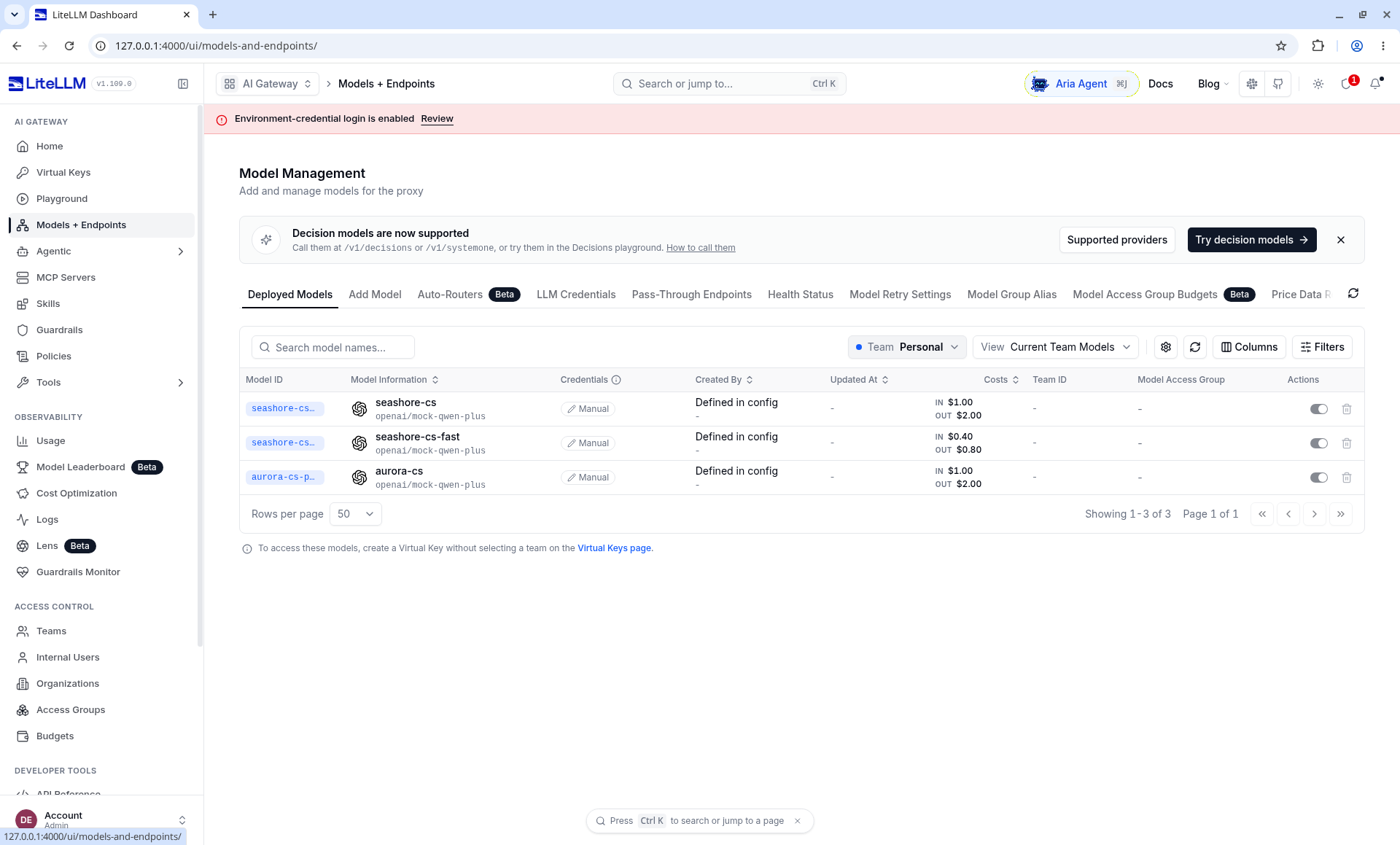
The price per million tokens is the unit price in the config times one million: 0.000001 displays as $1.00, and 0.0000004 displays as $0.40. Output is twice the input, so OUT is $2.00 and $0.80. These are experiment unit prices, not the official prices of Tongyi or OpenAI. The Model ID column is truncated. The third row shows the prefix aurora-cs-p, which matches the start of aurora-cs-primary in the config. The full id follows the config and the response header.
Clicking the seashore-cs row does not open a routing diagram.
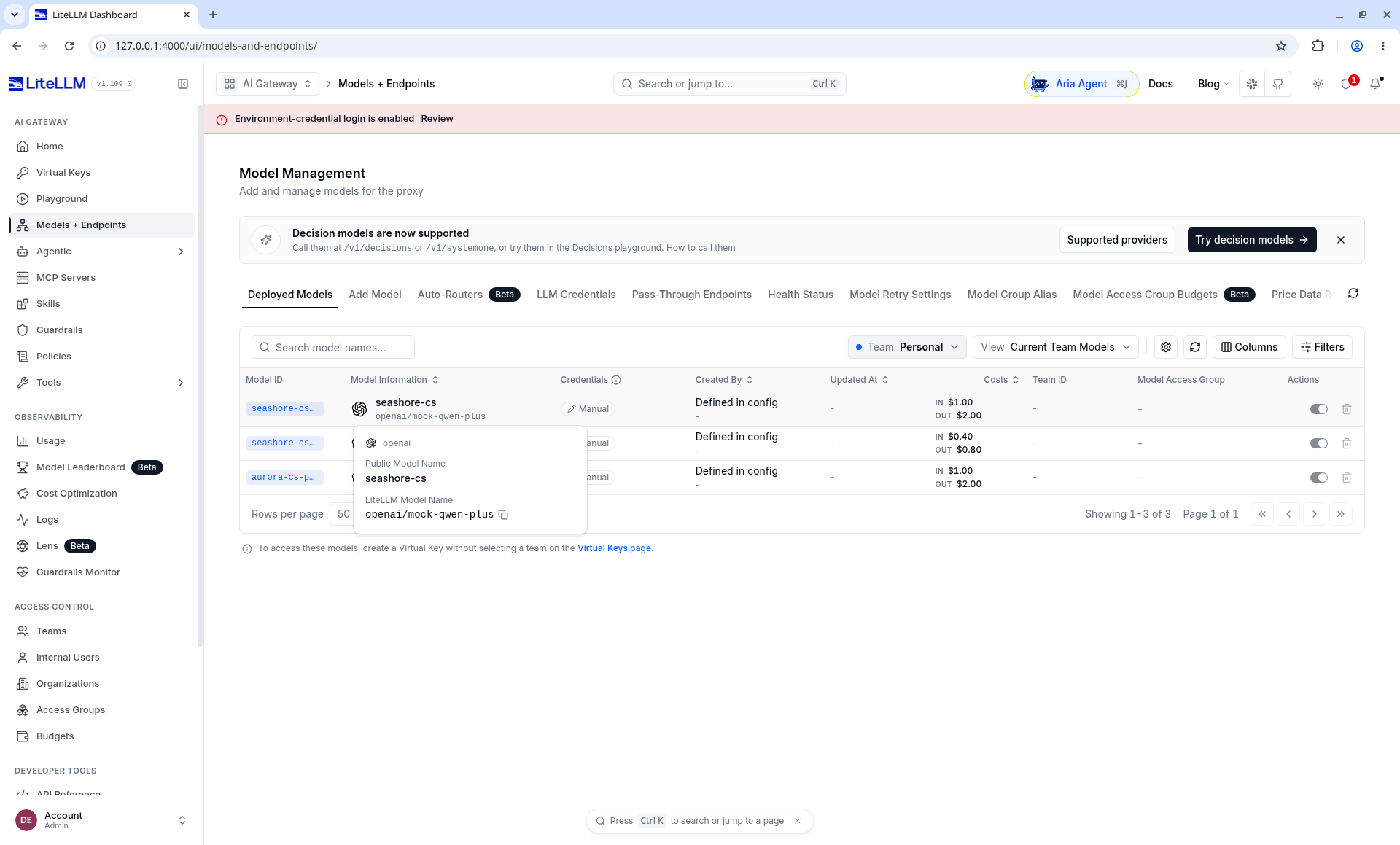
The popover splits "the business alias" and "the upstream model string" onto two lines. In this config the upstream model string of all three aliases is openai/mock-qwen-plus, so the popover cannot tell you whether this row uses 18001 or 18002. api_base is in the Trace. See the next section.
Auto-Routers and Model Group Alias on the same page are empty. Fallback is not on those two tabs. Settings → Router Settings → Fallbacks is where the row from seashore-cs to seashore-cs-fast lives. Chapter 7 opens it. The Decision models hint at the top of the page was not used.
Playground sends OD-2049 to mock-primary
The Models page proves the aliases are loaded. Which machine a request lands on is the Playground Trace. This run used the Current UI session after login, with the model set to seashore-cs. It was not alice's virtual key.
The sentence sent was 「查询订单 OD-2049 的物流状态」 ("Check the shipping status of order OD-2049"). With Stream response on, the first attempt hung. The screen below is what came back after it was turned off. The picture is the success after streaming was turned off. It is not a stream that finished by itself.
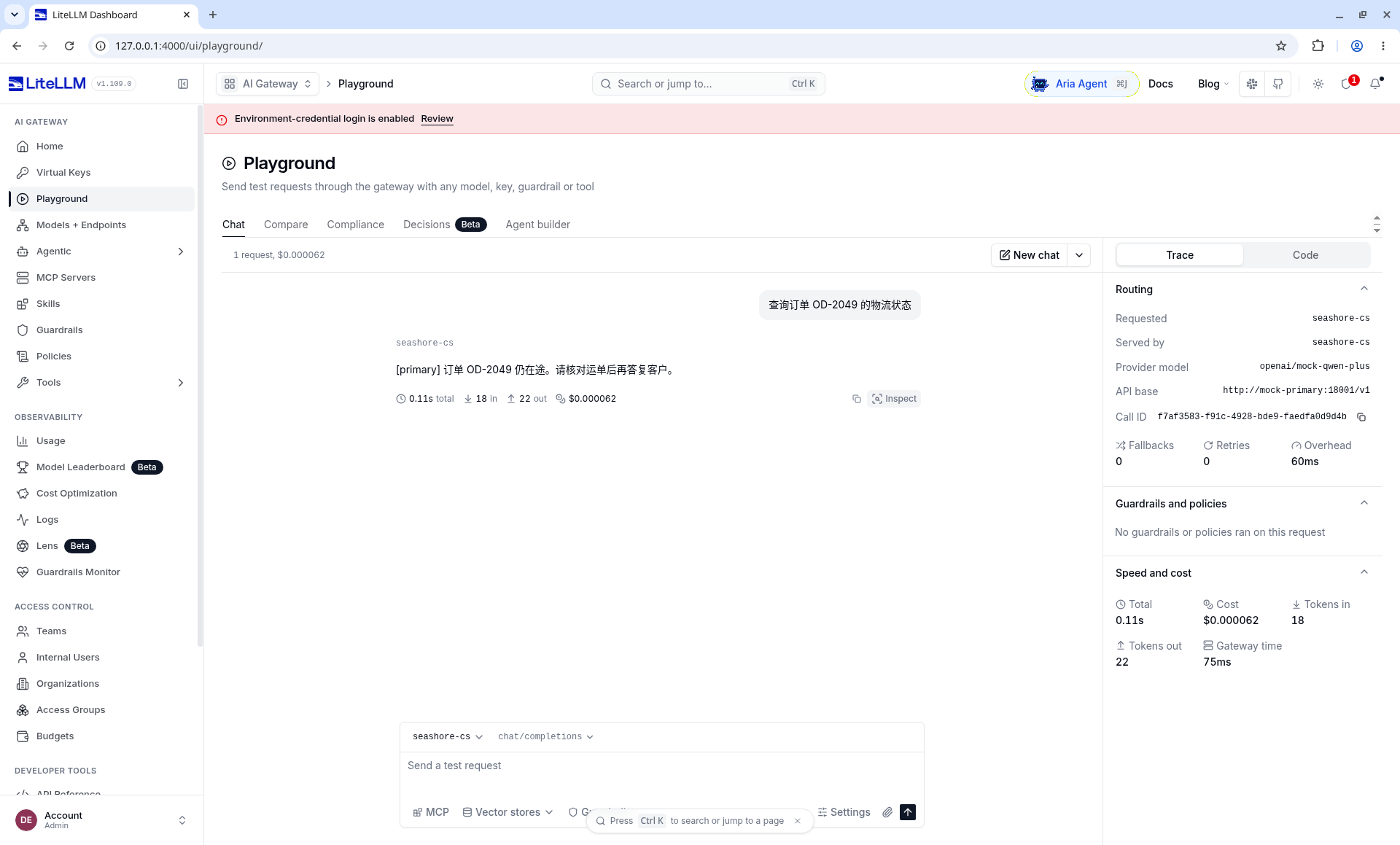
Rows on the Trace that line up:
| Words on the Trace | Value | What it means |
|---|---|---|
| Requested / Served by | seashore-cs |
The alias requested and the alias that served are the same. There was no fallback this time |
| Provider model | openai/mock-qwen-plus |
The same layer as LiteLLM Model Name in the popover. All three aliases look like this |
| API base | http://mock-primary:18001/v1 |
This row is what says "it hit primary". fast's config is mock-backup:18002 |
| Fallbacks / Retries | 0 / 0 | Matches num_retries: 0 and the fact that this call did not fail |
| Body prefix | [primary] |
The process name the simulator adds. A production upstream will not have this prefix |
| Cost | $0.000062 | 18 × 0.000001 + 22 × 0.000002. The Usage card shows the same kind of small amount as $0.00 |
Guardrails and policies says no guardrails or policies ran on this request. None were configured. The input at the bottom of the page is still on seashore-cs and chat/completions.
The Trace has a Call ID row. This book does not copy that string. It is the id of this one call, and a replay changes it.
Three layers of names
| Layer | Where it is configured | Xingfan's value | Who may change it |
|---|---|---|---|
| Business alias | model_name, also the request body model |
seashore-cs, seashore-cs-fast, aurora-cs |
Rarely. A change means changing the Agent definition and the key list |
| Deployment id | model_info.id |
seashore-cs-primary, seashore-cs-fast, aurora-cs-primary |
Added when machines or regions are added. The business alias does not change |
| Upstream model | litellm_params.model |
All three rows are now openai/mock-qwen-plus. On 2026-11-11 the fast row was openai/mock-qwen-turbo |
When the vendor changes, only this, api_base, and api_key change |
The openai/ prefix means "call with the OpenAI-compatible protocol". It does not name the vendor. The simulator does not check the key, but the config still goes through os.environ/MOCK_UPSTREAM_KEY, so nobody writes a real key into the yaml.
merchant-gateway in Step 13 is the Dataplane's teaching alias. It means "use the company gateway". It is not an upstream model name, and it is not this book's model_name. When both are called "alias", write them in full in the sentence: platform alias merchant-gateway, gateway alias seashore-cs. The first decides that the request is sent to llm.example.com. The second decides which deployment the gateway picks.
Two deployments under one alias, and two aliases, are not the same thing
The load-balancing docs say: several deployments with the same model_name are distributed by the router according to a strategy, default simple-shuffle. When rpm or tpm is set, simple shuffle draws by those weights. When they are not set, it is uniform random.
In this book's config.yaml, each model_name has only one deployment. simple-shuffle has no second candidate, so it simply selects that one. Seashore's "primary" and "standby" are two aliases, connected by router_settings.fallbacks, not by multiple deployments of the same name.
The reason to split them this way is that fallback has to change the unit price and the port, and the key list has to explicitly allow the standby alias. With multiple deployments of the same name, the standby is hidden inside the load strategy, /v1/models still shows one id, and the key list cannot refuse the standby alone. Xingfan wants Aurora's key to be unable to see Seashore's standby at all, so the standby has to be another model_name.
Multiple deployments of the same name are left for later: Seashore's primary model has two machines, both named seashore-cs, with model_info.id of seashore-cs-primary-a and seashore-cs-primary-b. That is the load in chapter 7. This chapter does not add a second entry to the experiment config, so it is not mixed into one request with the fallback that was already tested.
model in the response cannot be used as the alias
While the primary upstream is alive and the request is seashore-cs, the 2026-11-11 response JSON model was seashore-cs, and the response header x-litellm-model-id was seashore-cs-primary. In the 2026-11-12 Playground, with the primary alive, Trace Served by was also seashore-cs and API base pointed at mock-primary.
The successful fallback, with the primary process stopped, is the 2026-11-11 run. That day fast's upstream model was still openai/mock-qwen-turbo:
| Place | Value |
|---|---|
Request model |
seashore-cs |
Response model |
mock-qwen-turbo |
x-litellm-model-id |
seashore-cs-fast |
x-litellm-attempted-fallbacks |
1 |
| Body prefix | [backup] |
In that run the response model changed from the alias to the upstream id. The 2026-11-12 compose sets fast to openai/mock-qwen-plus as well and did not stop the primary again, so do not look for mock-qwen-turbo in the current UI. If Xiaofan writes the upstream id from the response back into the session, and the next turn sends it unchanged, the gateway receives a name that is not in /v1/models. The result is 400, the same class as requesting qwen-plus directly:
{
  "error": {
    "message": "/chat/completions: Invalid model name passed in model=qwen-plus. Call `/v1/models` to view available models for your key.",
    "type": "invalid_request_error",
    "code": "400"
  }
}
This request was sent to /v1/chat/completions. The error text still says /chat/completions. Both paths can return 200 on this machine (when the primary upstream was already stopped, the call without /v1 also landed on backup). Do not use the path inside the error text to decide which URL the client used.
The model name persisted in the session is only the business alias. The deployment id goes in logs and in Langfuse metadata, and in the response header. It does not go back into the request.
Do not over-read the fields of /v1/models
The master key sees three ids. Seashore's key sees two. Each record's owned_by is openai, created is 1677610602, and mode is chat. owned_by and created do not reflect the vendor, and they do not reflect when the deployment was created. mode: chat comes from the model_info.mode we wrote. If an embedding model is added later, use another model_name and set mode to embedding. The support key's list must not contain it.
A client may use this list as a dropdown. Do not route on owned_by.
The docs have another alias layer. This machine did not turn it on
router_settings.model_group_alias on the load-balancing page can map one external name, as a whole group, to another model_name, and it appears in /v1/models by default. For example, map the old name merchant-gateway as a group onto seashore-cs.
This machine did not configure it. The reason is the same as not configuring key-level aliases in chapter 3: Xingfan does not yet have an old name that must stay compatible. Step 13's merchant-gateway stays in the Dataplane. Platform code translates the tenant into seashore-cs or aurora-cs. If merchant-gateway is mapped on the gateway, fixed, onto seashore-cs, Aurora's requests also enter Seashore's deployment. That is an isolation incident, not compatibility.
model_group_alias fits "the same merchant changed the display name, the deployment did not change". It does not fit "one name serves every merchant".
Price and id are bound to the deployment
The unit price is written in each deployment's litellm_params, not on the business alias. seashore-cs and seashore-cs-fast have different unit prices, and the response headers already matched 6.2e-05 and 2.48e-05 separately. If two same-name deployments later have different unit prices, one simple-shuffle makes two neighboring calls of the same alias cost different amounts. If finance sets the unit price by alias, it will not match. The bill dimension uses x-litellm-model-id. When the external quote uses the alias, say "this is a ceiling or an average". Do not pretend every call is the same.
In the experiment, aurora-cs and seashore-cs point at the same simulator port and the same unit price. Only the deployment id differs. That is to start one fewer process. In production the two merchants can point at different vendors. Even if they point at the same upstream today, the key and the team stay separate. A shared upstream is not a shared ledger.
The business config keeps only the alias
Agent definitions, Spring config, and "which model was used" in a ticket all write seashore-cs or aurora-cs. The following strings are forbidden in the business repo:
| String | Why |
|---|---|
openai/mock-qwen-plus |
Experiment upstream id. All three aliases use it now |
mock-qwen-turbo |
Appeared only in the 2026-11-11 fallback response. Copying it back causes 400. The current config no longer produces it |
seashore-cs-primary |
Deployment id, only in logs and response headers |
http://127.0.0.1:18001 |
The simulator |
| Any vendor's real model name | It will be missed when the vendor changes |
seashore-cs-fast may appear in the gateway config and on the key list. The support agent's default request must not write it. Let fallback happen on the gateway. The business keeps requesting seashore-cs. If the business changes its own request to hit fast, the fallback policy is copied into every Java service, and the pre-check rule in chapter 7 is also bypassed.
What the config looks like when adding a machine of the same name
The block below was not loaded on this machine. It only shows which layer "load" and "fallback" should appear on. Do not paste it into the current config.yaml and then expect the experiment numbers of chapter 7 to stay the same.
model_list:
  - model_name: seashore-cs
    litellm_params:
      model: openai/contract-model-a
      api_base: https://vendor-a.example/v1
      api_key: os.environ/VENDOR_A_KEY
      rpm: 60
    model_info:
      id: seashore-cs-primary-a
  - model_name: seashore-cs
    litellm_params:
      model: openai/contract-model-a
      api_base: https://vendor-a-standby.example/v1
      api_key: os.environ/VENDOR_A_KEY
      rpm: 60
    model_info:
      id: seashore-cs-primary-b
  - model_name: seashore-cs-fast
    litellm_params:
      model: openai/contract-model-b
      api_base: https://vendor-b.example/v1
      api_key: os.environ/VENDOR_B_KEY
    model_info:
      id: seashore-cs-fast
vendor-a.example is not Xingfan's domain. It is only a placeholder in this untested draft, so it is not confused with llm.example.com. When you actually enable it, change it to the address in the contract. The two primary machines share the alias seashore-cs. rpm: 60 gives simple-shuffle a weight to follow. The docs say that when rpm/tpm/weight are not written, the draw is uniform random. If you write them, write them on both machines, or the weight rule treats the one you did not write as 0. The strategy page's own words are: as soon as one candidate from a source is a positive number, that source is used, and an unset candidate has weight 0. Writing rpm on only one machine starves the other. This machine did not verify that. When writing config, follow the docs and avoid writing only half.
Fallback still points at the other alias seashore-cs-fast. It is that alias's turn only after both primary machines have cooled down. The docs also allow a fallback to write a model_info.id directly, which skips the cooldown check. This machine's fallback writes the alias, not the id. The response header on the successful run is seashore-cs-fast, the same as the deployment id of that alias, because this alias has only one machine. The alias and the id being the same string is a coincidence of the experiment. Do not treat the two as one field in code.
The client caches the model list
created in /v1/models is the constant 1677610602. It cannot be used as "when the list changed". If a client caches the list for a whole day, an alias the gateway adds at noon does not appear, and an alias deleted at noon is still requested, then 400. Support's dropdown can pull the list once at the start of each session. Do not commit this JSON into the repo as a static file.
Seashore's key cannot see aurora-cs. The cache key must include the key. It cannot be one global models.json. A global cache would send the three aliases the master key sees to every merchant's browser. That is an isolation incident. If the dropdown is built in the platform backend, the backend pulls the list with that merchant's virtual key. Do not embed the master key's list result into the frontend.
Experiment unit prices lined up with aliases
| Alias | Deployment id | Unit price (per token, input / output) | Hand calculation for 40 tokens | Response header |
|---|---|---|---|---|
seashore-cs |
seashore-cs-primary |
0.000001 / 0.000002 | 0.000062 | 6.2e-05 |
seashore-cs-fast |
seashore-cs-fast |
0.0000004 / 0.0000008 | 0.0000248 | 2.48e-05 |
aurora-cs |
aurora-cs-primary |
Same as primary | 0.000062 | Aurora's call did not have the header excerpted on its own. The posted amount is 6.2e-05 |
The hand calculation matches the response header, which is what shows that "the deployment the alias selected" and "the deployment used for pricing" are the same entry. If a fallback were still posted at the primary unit price, this table would not match. This machine matched, so fallback pricing used the fast unit price.
Before leaving this chapter
- State the three name layers, with one Xingfan value for each.
- Request
qwen-pluswith the master key and confirm 400, not 403. - On one successful fallback, look at response
modelandx-litellm-model-idtogether, and confirm they can differ. - Search the business repo. There is no
mock-qwenand no127.0.0.1:18001. - If
merchant-gatewayis still in an Agent definition, list the names to change into tenant aliases. Do not map it to a single merchant on the gateway.
Read next
- Chapter 7 turns fallback on for these aliases, and says when multiple deployments of the same name are worth adding.
- The provider table in AgentScope Java chapter 21 still decides which Java extension the Dataplane uses. A gateway alias does not replace that extension. The extension is OpenAI-compatible, and
baseUrlpoints atllm.example.com. - Model routing in chapter 41 is a choice inside the Agent runtime. The string it selects should already be a gateway alias, not a vendor model name.